INDEX

Topics are arranged alphabetically in the INDEX.
Showing posts with label logic. Show all posts

Thursday, August 10, 2017

Geometry and Experience according to Albert Einstein


Math has its own indisputable logic. In this sense, it has greater certainty than most sciences.

This is the address given to the Prussian Academy of Sciences by Albert Einstein on January 21, 1921 in Berlin.


Related reading: John Lennox on Nonsense; Blaise Pascal; Using Arab Math to Uncover Authors of Torah

Monday, September 7, 2015

Progressives enjoy attacking Kim Davis


What follows is an excerpt from a piece written by a philosopher who is less concerned about the question of homosex than about fallacious reasoning on the part of so-called "Progressives."


Kim Davis, a county clerk in Kentucky, has been the focus of national media because of her refusal to issue marriage licenses to same-sex couples. As this is being written, Davis has been sent to jail for disobeying a court order.

As should be expected, opponents of same-sex marriage have tended to focus on the claim that Davis’ religious liberty is being violated. As should also be expected, her critics sought and found evidence of what seems to be her hypocrisy: Davis has been divorced three times and is on her fourth marriage. Some bloggers, eager to attack her, have claimed that she is guilty of adultery. These attacks can be relevant to certain issues, but they are also irrelevant in important ways. It is certainly worth sorting between the relevant and the irrelevant.

If the issue at hand is whether or not Davis is consistent in her professed religious values, then her actions are clearly relevant.


Read it all here.

In the ancient world, she would have been stoned to death by these people. That way everyone was seen to be in agreement about her guilt and nobody could be identified as her killer. Progressives are not progressive when it comes to breaking ranks.

As G.K. Chesterton wrote, "He is only a very shallow critic who cannot see an eternal rebel in the heart of the Conservative." (Varied Types, 1903)


Tuesday, December 23, 2014

Student Graphics Illustrate Fallacies


Anna Price – Chronological Snobbery
(Copy Reads): The mindset that sees an idea, way of thinking, culture, art, or science of an earlier time as inferior, based solely on the assumption that whatever is newer is better. For example: "It is really hard for me to enjoy Medieval art – after all, these are people who didn't even have indoor plumbing."


This is an excellent project! See more examples of the students' posters here.


Related reading: Fallacies; Logic on the Lighter Side; Why Logic Should Be Taught in Schools


Saturday, April 13, 2013

Logic: On the lighter side


Alice C. Linsley

Pick your stick figure: Clean-Shaven or Goatee Guy. Clean-Shaven states that Modal Logic is "special" and gives attributes which we are to assume make Modal Logic "special."

Goatee Guy does most of the talking. He uses words like complex, claim, conclusion, problem.

Are these two figures in the same world metaphysically speaking?
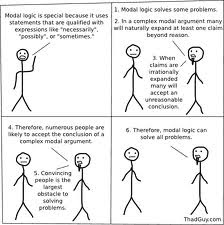


1.Clean-Shaven says, "Modal logic is special because it uses statements that are qualified by expressions like 'necessarily', 'possibly', or 'sometimes.' Modal logic solves some problems."

2. Goatee Guy says, "In a complex modal argument many will naturally expand at least one claim beyond reason."

3. Goatee Guy says, "When claims are irrationally expanded many will accept an unreasonable conclusion."

4. Goatee Guy says, "Therefore, numerous people are likely to accept the conclusion of a complex modal argument."

5. Goatee Guy says, "Convincing people is the largest obstacle to solving problems."

6. Goatee Guy says, "Therefore, modal logic can solve all problems."


So which is it? Modal logic solves some problems or modal logic solves all problems.

Can both be valid claims? Would this be allowed by Aristotle's First Principles? What about the Laws of Identity and Non-Contradiction?

In what possible world would such contradiction possibly exist? Under what conditions? (Think about our enactment of the courtroom scene with the different witnesses. Think of the contrast between the naked spear-throwing Amazon native who laughs at the idea of a man walking on the moon and the rich American who pays for a trip to the moon.)


Saul Kripe

Saul Kripke began his work on the semantics of modal logic while he was in high school. His groundbreaking paper, “A Completeness Theorem for Modal Logic,” was published in the Journal of Symbolic Logic in 1959 during Kripke’s freshman year at Harvard.

Kripke’s most important publication, Naming and Necessity (1980), was based on three lectures he delivered at Princeton in 1970. The book provides an account of necessity and possibility as metaphysical concepts. It distinguishes necessity and possibility from a posteriori knowledge and a priori knowledge and from the semantic notions of truth by virtue of meaning and truth by virtue of fact. In the course of making these distinctions, Kripke revived the ancient doctrine of essentialism, according to which objects necessarily possess certain properties without which the objects would not exist. Here Kripe goes back to ontology. He maintains the existence of contingent a priori truths, to which Michael Dummett reacts, maintaining that there is something wrong with Kripe's logic.

In modal logic claims are said to be deeply contingent or superficially contingent.


Necessary versus contingent

Analytic propositions are the focus of Analytical Philosophy and Modal Logic. An analytic proposition is a statement or judgment that is necessarily true on logical grounds and serves only to elucidate meanings already implicit in the subject. The truth of such a proposition is guaranteed by the principle of contradiction. An analytic proposition is distinguished from a synthetic proposition which derives meaning from nonlogical and/or sense data which, as Bacon, Berkeley and others have demonstrated, are contingent upon the one sensing and their circumstances.

To illustrate this distinction, think of Descartes' proposition that all bodies are extended. This is an analytic proposition because the idea of extension is implicit in the notion of body; whereas the proposition that all bodies are heavy is synthetic, since in addition to the notion of body, the notion of weight supposes the notion of bodies in relation to one another. Without a point of reference, "heavy" means nothing and with a point of reference "heavy" is synthetic.

In the 19th century Bernard Bolzano added a third category, the analytically false. He held that a sentence is analytically true if either (1) its propositional form is true for all values of its variables or (2) it can be reduced to such a sentence.

Gottfried Wilhelm Leibniz made a parallel distinction between “truths of reason” and “truths of fact,” and David Hume distinguished between “relations of ideas” and “matters of fact.”

In the mid-20th century, the distinction between analytic and synthetic statements stirred extensive debate in view of objections raised by the American logician Quine. Quine also goes back to ontology in his statement: "To be is to be the value of a bound variable."

Quine once heard a talk at Harvard by a famous philosopher. Afterwards Quine was asked what he thought of the talk, and he replied, “He paints with a broad brush.” Then he added, “and he thinks with one too!” Quine's mind was such that he must have regarded the majority of humans to be mired in ambiguity.


Immanuel Kant

Having been aroused from his philosophical slumber by David Hume, Immanuel Kant made a distinction between statements whose predicate is included in the subject (analytic statements) and statements whose predicate is not included in the subject (synthetic statements). The distinction was introduced by Kant in The Critique of Pure Reason.

For Kant, "predicate" refers to what can be said or predicated about something. Anything that can be publicly declared and asserted about something is a predicate. Kant called an attribute, property, quality, or characteristic that can be predicated about something a "category." Kant's category does not mean classification, but merely some object generally known. Kant wrote, "…I remark concerning the categories…that their logical employment consists in their use as predicates of objects." He called them "ontological predicates."


Related reading: Theories of Change and Constancy; Liebniz' Modal Metaphysics; Modal Logic and Problem Solving; Why Logic should Be Taught in Schools; Introduction to Logic: Fallacies; Pioneers in the Field of Logic


Sunday, April 7, 2013

Introduction to Logic: Fallacies


Logic is the study of reasoning and the process by which an argument can be determined to be logical, valid and sound. Logicians analyze arguments, premises, inferences, propositions, conditional statements, and symbolic forms.

Logic should not be confused with epistemology which explores theories of knowledge. Logic is concerned with how we reason.

Aristotle was one of the earliest philosophers to articulate principles of logic. His most famous works on Logic are: Categories; On Interpretation; Prior Analytics; Posterior Analytics; Topics; and Sophistical Refutations. Aristotle insisted that his students reason according to the Laws of Identity, Non-contradiction, and the Excluded Middle. He called these "first principles".

Other famous works on Logic include:

Francis Bacon: Novum Organum

Descartes: Discourse on Method

John Dewey: Reconstruction In Philosophy

John Stuart Mill: System of Logic

W.V. Quine, Mathematical Logic

Bertrand Russell: The Problems of Philosophy; The Principles of Mathematics

Gilbert Ryle: Dilemmas

Ludwig Wittgenstein: Philosophical Investigations

Rudolf Carnap, Introduction to Symbolic Logic and its Applications

Alonzo Church, Introduction to Mathematical Logic

M.R. Cohen and Ernest Nagel, An Introduction to Logic and Scientific Method

W.W. Fearnside and W.B. Holther, Fallacy -- The Counterfeit of Argument


As a branch of philosophy, logic has many subsets: modal logic, many-valued logic, modern logic, symbolic logic, formal and informal logic, deductive and inductive logic.

Our study of logic is designed to help the student identify fallacies. A fallacy is an invalid form of argument, and represents an instance of incorrect reasoning. There are numerous fallacies. Below is a list of common fallacies.

affirming the consequent

anthrocentric fallacy

appeal to authority

a priori fallacies

arguing from "is" to "ought"

argumentum ad baculinum

argumentum ad captandum

argumentum ad crumenam

argumentum ad hominem

argumentum ad ignorantiam

argumentum ad lazarum

argumentum ad misericordiam

argumentum ad populum

argumentum ad verecundiam (see "appeal to authority")

argumentum ex silentio

begging the question

circular reasoning

equivocation

fallacy of false alternatives

fallacies of interrogation

flamboyance

gadarene swine fallacy

genetic fallacy

hasty generalization

if-then fallacies

ignoratio elenchi

invincible ignorance

naturalistic fallacy

non sequitur

paralogism

performative contradiction

petitio principii (see "begging the question")

poisoning the wells

post hoc ergo propter hoc

red herring

straw man fallacy

tu quoque fallacy

undistributed middle

Fallacies generally can be avoided by following Charles Sanders Peirce's 3 rules of reason.

"Upon this first...rule of reason, that in order to learn you must desire to learn, and in so desiring not be satisfied with what you already incline to believe, there follows one corollary which itself deserves to be inscribed upon every wall of the city of philosophy: Do not block the way of inquiry."--Charles Sanders Peirce, 1896


Related reading: Dorothy Sayers' Lost Tools of Learning; A Pragmatic Approach to Knowledge; Student Graphics Illustrate Fallacies; Logic on the Lighter Side